Partial Knee Replacement in Noida is a specialized orthopaedic procedure for patients whose knee arthritis or joint damage affects only one compartment of the knee. Also known as Unicondylar Knee Replacement (UKR) or Unicompartmental Knee Replacement, this procedure replaces only the damaged portion of the knee while preserving healthy bone, cartilage, ligaments, and other joint structures where possible.
At Dhawan Joint & Bone Care, Dr. Tushar Dhawan provides orthopaedic consultation and treatment guidance for patients experiencing knee pain, stiffness, and restricted movement. The suitability of partial knee replacement depends on the extent of joint damage, ligament function, knee alignment, and the patient's overall health.
Partial knee replacement is a surgical procedure in which only the damaged compartment of the knee joint is replaced with an artificial implant. Unlike total knee replacement, which replaces multiple joint surfaces, UKR preserves the unaffected compartments of the knee.
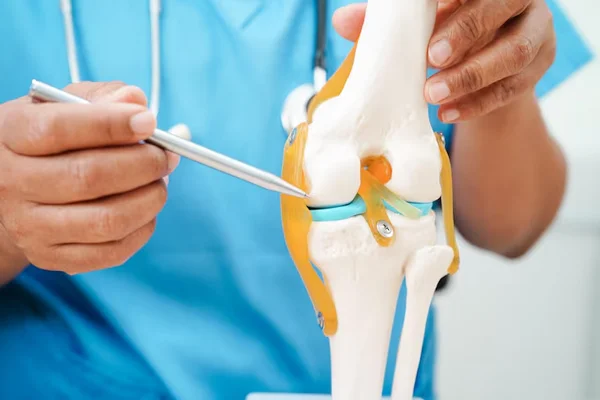
The knee has three main compartments: medial (inner), lateral (outer), and patellofemoral (front). Partial knee replacement may be considered when significant arthritis is confined to one compartment and the remaining joint structures are sufficiently healthy.
The main goals of the procedure are to relieve pain, improve knee function, and help eligible patients return to everyday activities.
Partial knee replacement may be suitable for selected patients with localized knee joint damage that significantly affects mobility and quality of life.
Common indications include:
Localized Knee Osteoarthritis: Arthritis primarily affecting one compartment of the knee.
Persistent Knee Pain: Pain that continues despite appropriate medication, physiotherapy, and other conservative treatments.
Restricted Knee Movement: Stiffness and reduced mobility associated with compartment-specific joint damage.
Preserved Healthy Compartments: The remaining portions of the knee joint are sufficiently healthy for a partial replacement.
Suitable Ligament Function: The knee ligaments, particularly the anterior cruciate ligament in many cases, provide adequate stability.
Difficulty With Daily Activities: Pain that interferes with walking, standing, or climbing stairs.
A detailed clinical assessment and imaging are necessary to determine whether UKR is appropriate. It is not suitable for every patient with knee arthritis.
The type of partial knee replacement depends on which compartment of the knee is affected.
This procedure replaces the damaged medial compartment on the inner side of the knee. It is commonly considered when osteoarthritis is mainly limited to this area.
Lateral partial knee replacement addresses damage in the outer compartment of the knee. It may be recommended for selected patients with localized lateral compartment arthritis.
In selected cases, arthritis may primarily affect the joint between the kneecap and thigh bone. A patellofemoral replacement treats this specific area while preserving the other compartments.
The appropriate procedure depends on the location and severity of the damage and the condition of the surrounding joint structures.
For appropriately selected patients, partial knee replacement may offer several benefits compared with total knee replacement.
Preserves Healthy Bone: Only the damaged compartment is replaced.
Smaller Surgical Intervention: The procedure generally involves less extensive joint replacement.
Potentially Faster Recovery: Eligible patients may regain mobility sooner than after total knee replacement.
Natural Knee Movement: Preserving healthy structures may help maintain a more natural feeling of knee movement.
Reduced Blood Loss: Partial replacement may involve less blood loss in suitable cases.
Improved Daily Function: Pain relief may help patients walk and perform everyday activities more comfortably.
Individual outcomes vary, and partial knee replacement is not necessarily better than total knee replacement for every patient.
The key difference is the amount of the knee joint that is replaced.
Partial Knee Replacement (UKR): Replaces only the damaged compartment and preserves the unaffected portions of the knee.
Total Knee Replacement (TKR): Replaces the damaged joint surfaces across the main compartments of the knee.
UKR may offer a less extensive procedure and potentially quicker recovery for suitable patients. However, total knee replacement may be more appropriate when arthritis affects multiple compartments, there is significant deformity, or other factors make partial replacement unsuitable.
Your orthopaedic surgeon can explain the advantages, limitations, and expected outcomes of each option following a thorough evaluation.
Before surgery, the orthopaedic surgeon assesses the knee through a physical examination, medical history, and imaging investigations. These assessments help determine whether the arthritis is confined to one compartment and whether the knee is suitable for partial replacement.
During surgery, the damaged joint surfaces in the affected compartment are replaced with artificial components. Healthy portions of the knee are preserved wherever possible.
After the procedure, the medical team monitors recovery and provides guidance regarding pain management, wound care, mobility, and rehabilitation.
Recovery after partial knee replacement involves gradual mobilization and a personalized rehabilitation plan. Many patients can begin standing or walking with assistance on the day of surgery or shortly afterward, depending on their condition and the treating team's recommendations.
Recovery may involve:
Early Mobilization: Walking with support as advised by the medical team.
Knee Movement Exercises: Improving flexibility and range of motion.
Muscle Strengthening: Building strength in the quadriceps and surrounding muscles.
Balance Training: Improving stability during everyday activities.
Progressive Rehabilitation: Gradually returning to routine activities as healing progresses.
Follow-Up Assessments: Monitoring recovery and addressing any concerns.
Many patients return to routine activities within several weeks, although recovery varies. Following prescribed exercises and avoiding excessive strain during healing are important.
Dr. Tushar Dhawan is a Consultant Orthopaedic Surgeon specializing in joint replacement, arthroplasty, arthroscopy, and trauma care. At Dhawan Joint & Bone Care, he provides orthopaedic evaluation and treatment guidance for patients experiencing knee pain and restricted movement.
Patients can expect:
Comprehensive Knee Assessment: Evaluation of pain, joint damage, alignment, and mobility.
Individualized Treatment Planning: Recommendations based on the severity and location of arthritis.
Joint Replacement Expertise: Training in joint replacement techniques and arthroplasty.
Clear Treatment Guidance: Explanations of partial replacement, total replacement, and non-surgical alternatives.
Recovery-Focused Advice: Guidance on rehabilitation, mobility, and follow-up care.
The final treatment recommendation depends on clinical findings and the patient's individual needs.
Persistent knee pain can interfere with walking, climbing stairs, and everyday activities. If arthritis is limited to one compartment of your knee and non-surgical treatments have not provided sufficient relief, partial knee replacement may be an option worth discussing.
Consult Dr. Tushar Dhawan at Dhawan Joint & Bone Care in Noida for an orthopaedic assessment and personalized guidance on whether Unicondylar Knee Replacement (UKR) is suitable for your condition.
Partial knee replacement, also called Unicondylar Knee Replacement, is a procedure that replaces only the damaged compartment of the knee while preserving the healthy portions of the joint.
Patients with arthritis limited mainly to one knee compartment, adequate ligament function, and suitable joint alignment may be candidates. An orthopaedic assessment and imaging are necessary to confirm suitability.
Neither procedure is universally better. UKR may offer a less extensive operation and potentially faster recovery for suitable patients, while total knee replacement may be more appropriate for widespread arthritis.
Many patients resume routine activities within several weeks. Recovery depends on overall health, the surgical procedure, rehabilitation, and individual healing progress.
Yes, knee bending is gradually encouraged through prescribed exercises. The timing and range of movement depend on the surgeon's instructions and the patient's recovery.
You can consult Dr. Tushar Dhawan at Dhawan Joint & Bone Care in Noida for an assessment of knee arthritis and guidance on partial or total knee replacement options.


